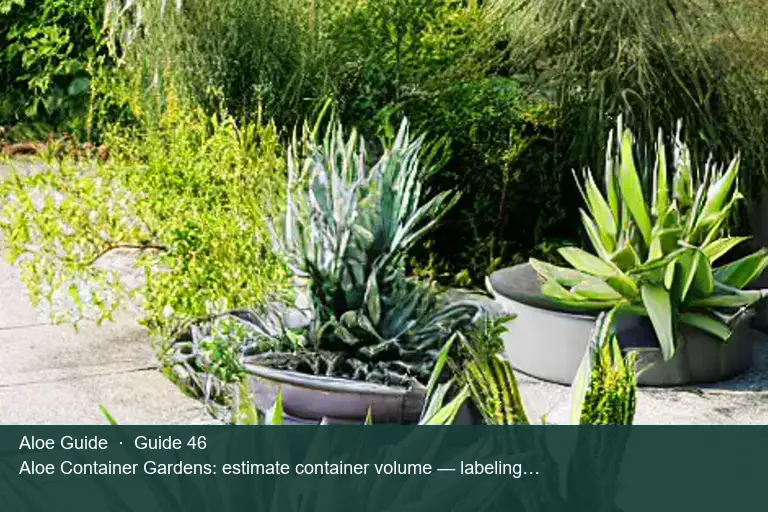
Aloe Container Gardens: estimate container volume — labeling scheme for shared plant care; setup for a first project
### Aloe Container Gardens: Estimating Container Volume and Labeling Scheme for Shared Plant Care
In today’s world, more and more people are turning to container gardens for their plant care needs. Aloe containers are an excellent choice for those looking to grow succulents, cacti, or other plants in containers. However, when it comes to estimating container volume, it is essential to ensure that the containers are properly sized for the plants and that the labels are accurate.
In this article, we will discuss the process of estimating container volume and provide a step-by-step guide on how to label aloe container gardens. We will also share some practical tips for setting up a first project for shared plant care.
**Estimating Container Volume**
When estimating the volume of aloe container gardens, it is important to consider the size of the plants and the containers. The volume of a container is determined by its depth and width. To estimate the volume of a container, you need to measure the depth and width of the container and multiply them together. For example, a 40-gallon container with a depth of 8 inches and a width of 20 inches will have a volume of 320 cubic inches.
**Labeling Scheme for Shared Plant Care**
When labeling aloe container gardens, it is essential to ensure that the labels are clear and easy to read. The labels should include the name and species of the plants, the container type, and the container depth and width. Additionally, it is recommended to include a label for the container itself, such as "Aloe Container 40-gallon" or "Aloe Container 20-inch x 8-inch".
**Setting Up a First Project for Shared Plant Care**
In order to set up a first project for shared plant care, it is important to gather the necessary materials and tools. It is recommended to gather a variety of plants and containers, as well as labels. You can also purchase a container organizer or use a box with compartments to help keep the containers organized.
Once you have the materials and tools, it is time to start the first project. Begin by placing the containers in a central location, such as a garage or a shared storage area. Label the containers with the plant name and species, the container type, and the container depth and width. Once the labels are in place, it is time to start planting the plants. Once the plants are planted, it is important to water them and to keep the containers clean and dry.
**Conclusion**
In summary, estimating container volume and labeling aloe container gardens are essential steps for shared plant care. By following the steps outlined in this article, you can ensure that your plants are growing in a healthy and productive way. In conclusion, the first project for shared plant care is to create a first project, and it is essential to gather the necessary materials and tools, and to label the containers with the plant name and species, the container type, and the container depth and width.